Artificial intelligence is changing the way we work, learn, research, design, and solve problems—and the painting industry is no exception.
At Casanova Painting, we have started to see some interesting ways that AI can be useful to both homeowners and painting contractors. From helping homeowners visualize a new colour scheme to researching potential solutions to a painting problem, AI can be an incredibly powerful tool.
But there is an important distinction that needs to be made:
AI is a tool. It is not the procedure, and it should never be the final step in making a professional painting decision.
We recently experienced a good example of this firsthand.
When a Painting Problem Meets AI
During one of our projects, we ran into an issue that required some investigation. The homeowner, understandably wanting to understand what was happening, used ChatGPT to research the problem and explore possible solutions.
Honestly, we thought that was pretty admirable.
The response generated by AI was well thought out. It provided possible explanations, discussed contributing factors, and even suggested several potential solutions.
And this is where AI can be incredibly helpful.
It can help someone understand the terminology. It can organize information. It can suggest questions to ask a professional. It can help a homeowner understand that there may be several possible causes for a problem rather than just one obvious answer.
But there was something AI could not physically do.
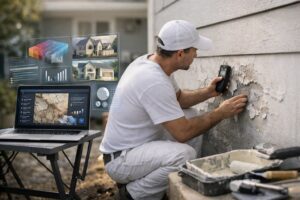
- It couldn’t stand in front of the wall.
- It couldn’t feel the surface.
- It couldn’t see exactly how the coating was reacting in different areas.
- It couldn’t measure the actual surface temperature with its hands or determine the conditions on that particular day.
- And it couldn’t physically examine the sheen, substrate, moisture, texture, previous coatings, or preparation that had taken place.
Those details matter.
A Painting Surface Is More Than a Picture
One of the challenges with using AI for painting advice is that painting is extremely dependent on physical conditions.
Two walls can look almost identical in a photograph but behave completely differently when you actually put a coating on them.
A professional painter is looking at things such as:
- What is the existing surface?
- What coating is currently on it?
- What is the sheen?
- Has the surface been properly cleaned?
- Is there moisture present?
- What is the surface temperature?
- What is the air temperature?
- What is the humidity?
- How long has the previous coating cured?
- Has the surface been repaired?
- What materials were used for those repairs?
- How much preparation was completed?
- How is the new coating actually behaving as it is applied?
AI can help explain why some of these factors matter.
But it cannot physically inspect the wall.
That is a very important difference.
AI Can Give You Possibilities—Not Always the Answer
This doesn’t mean AI is useless for painting.
Quite the opposite.
A good AI tool can be a fantastic starting point.
For example, a homeowner might ask:
“Why is my exterior paint bubbling?”
AI may identify several possibilities, including moisture, adhesion problems, surface contamination, incompatible coatings, excessive heat, or issues with the substrate.
That’s useful information.
But those possibilities still need to be investigated.
The actual solution depends on what is happening on that particular surface, at that particular property, under those particular conditions.
This is where experience becomes important.
A professional painter isn’t simply following a list of possible causes. They are observing the surface, asking questions, looking at the surrounding conditions, considering the history of the project, and determining what makes sense based on what they are actually seeing.
Sometimes the answer is obvious.
Sometimes it isn’t.
And sometimes the correct approach is to investigate further before doing anything at all.
AI Is Also Changing the Creative Side of Painting
The benefits of AI aren’t limited to solving problems.
We’ve also seen homeowners use AI in a completely different—and pretty exciting—way.
One client used AI to help modernize the appearance of her home and visualize some of her ideas.
That was actually really cool to see.
Instead of trying to explain a design idea only through words, AI helped turn those ideas into something visual.
For a homeowner, that can be extremely useful.
You can experiment with:
- Exterior colour combinations
- Front door colours
- Trim colours
- Accent walls
- Modern colour palettes
- Different design directions
- Ideas for updating an older home
- How a particular colour might look in a space
- It can help a homeowner communicate what they are imagining before the first drop cloth is even put down.
- And that can make conversations between homeowners and painting professionals much easier.
But There Is Still a Human Being Behind the Paintbrush
This is where we think the future of painting gets interesting.
AI isn’t necessarily something painters should be afraid of.
It is something painters can learn to use.
A professional painter can use AI to research products, organize information, explore colour combinations, create content, communicate ideas, and even help explain technical concepts to customers.
But when it comes to actually painting the house, there is still a human being involved.
Someone has to inspect the surface.
Someone has to recognize when something doesn’t look right.
Someone has to determine whether the substrate is ready.
Someone has to make adjustments when the conditions change.
Someone has to know when the manufacturer’s instructions need to be followed precisely.
And someone has to stand back at the end of the day and look at the work.
That’s where experience matters.
Human Error and Human Success
There is another part of this conversation that doesn’t get discussed enough.
People make mistakes.
Painters make mistakes. Homeowners make mistakes. Contractors make mistakes.
AI can help reduce some mistakes by giving us access to more information and helping us think through problems.
But humans are also responsible for the victories.
That moment when a difficult surface finally comes together.
When a colour looks exactly the way the homeowner imagined.
When an old house gets a completely different appearance.
When a complicated repair is successfully completed.
When a customer walks through the finished project and says, “This is exactly what I wanted.”
Those experiences aren’t just data.
They are the result of people making decisions, adapting, communicating, working with their hands, and sometimes figuring things out when things don’t go exactly according to plan.
The Future of Painting May Be AI-Assisted—Not AI-Run
We believe there is a place for AI in the painting industry.
- It can help homeowners become more informed.
- It can help painters research and communicate.
- It can help with colour visualization.
- It can help identify questions that should be investigated.
- It can even help us look at a problem from a different perspective.
But there is a big difference between using AI to assist a professional decision and allowing AI to make the professional decision.
A computer can give you information.
A painter has to interpret that information in the real world.
That’s especially important when dealing with existing homes, older coatings, unusual substrates, moisture, repairs, weather conditions, temperature, humidity, or anything else that can’t be fully understood from a photograph or a written description.
AI Is a Tool—Not the Procedure or the Final Step
At Casanova Painting, we think the best way to look at AI is fairly simple:
Use it. Learn from it. Ask it questions. Let it help you explore ideas.
But don’t stop there.
Take that information and combine it with professional experience, proper preparation, manufacturer’s specifications, and an actual inspection of the surface.
AI can help point you in a direction.
A professional painter still needs to determine where the road actually goes.
The painting industry has always evolved with new tools, new products, better equipment, and new technology. AI is simply the next tool being added to the toolbox.
And like any tool, its value depends on how it is used.
At the end of the day, painting is still a very physical and very human trade.
There is something to be said for standing in front of a wall, seeing the surface with your own eyes, understanding what it needs, putting in the preparation, applying the coating correctly, and then stepping back to see the finished result.
AI can help us get there. But it shouldn’t be the final decision that gets us there.
— David Casanova
Casanova Painting
778782008